


Done properly and your PT business will get more bookings and grow faster.
4 Key Takeaways
Now some, old school, personal trainers will read that headline of this post and scoff.
Much in the same way executives at Blockbuster laughed when the co-founders of Netflix offered to sell Netflix to Blockbuster.
As Marc Randolph, co-founder of Netflix, later said about the meeting - they laughed us out of the room.
"But I think the more important lesson - a lesson that Blockbuster learned too late - is simply this: 'If you are unwilling to disrupt yourself, there will always be someone willing to disrupt your business for you.'"
And that’s what personal trainers who are going all in on Google Business Profile (GBP) are going to do to PT’s without a GBP.
The question is...
Do You Want to Be Like Blockbuster or Netflix?
The executives at Blockbuster thought they were sitting pretty. The way they ran the business was successful and they didn’t need to change.
Then Netflix comes along with a different way to get and keep customers and become the long- term winner?

Is your PT business like Blockbuster or Netflix?
And this is important to you because…
If you’re unwilling to change how you get clients. Another personal trainer will come into your area, disrupt your business and take clients from you.
Now if you’ve read my other posts or done my quiz about succeeding as a personal trainer in this new AI age. Then you know the way to avoid that happening is to optimize your Google Business Profile properly.
But it doesn’t just end there.
This Checklist Template For Personal Trainers Helps Your PT Business Grow
Get the Client Attracting Google Business Profile Checklist Template For Personal Trainers. And you’ll also be signed up to get tips to keep your PT business growing.
And why's that important...

It's one of the easiest ways to get more bookings and earn more money as a PT.
Because a recent study by Whitespark showed AI Overviews appear for 68% of local searches.
So what you might say?
Well if your PT business is one of the ones AI mentions. Your bookings are likely to soar higher than a client's heart rate when you say, “Just one more rep.”
In this short guide I'll show you an easy tactic to do to improve your chances of being mentioned.
And the first thing is…
How To Make Your Location Page Loved By Google & AI
Now should I burst your bubble?
Hell yeah, this is too important.

To get some computer love from Google and AI use facts over generic info.
When was the last time you took an honest look at your location page.
You know, the page that says something like "We serve the Austin area" and then just lists your services.
Now that sometimes worked in the past, because humans skim. And when we’re busy who’s got the time to fact check everything.
But AI search tools like Google's AI Overviews, ChatGPT etc don't skim.
If your page has a stock photo image and is light on verifiable facts. Google and AI models move on to a competitor who actually put in the work to do a proper location page.
If you’ve done your page properly, I tip my hat to you.
For everyone else you have to realise, your location page isn't about chasing algorithms. It's about being genuinely specifically local instead of generically local.
Here's exactly how to fix that with 3 easy to do tactics.
Tactic 1: Fact Density (Give Google & AI Real, Helpful Data)
"Fact density" just means stop writing bland paragraphs and start giving precise information.
AI systems are pattern-matchers, they love data they can easily get hold of, like a table, rather than data buried in flowery prose about your "passion for fitness."
Build these into every location page:
The rule of thumb here is:
Structure beats more words. A table listing your rates and session types will get pulled into an AI answer far faster than three paragraphs saying you're "committed to results."
Tactic 2: Geographic Legitimacy (Prove You're Not a Ghost Gym)
Here's the one many PT’s just don’t realise and – it’s like you being in the 225 lbs bench press club - keeps you way ahead of them.
The photos you put on your location page matter a lot.
Why?
Because AI can literally look at your photos and judge whether you're real. If your location page uses stock photos of anonymous smiling people in a generic gym.
The AI reads that as "no idea where this business actually is" and quietly cites someone who used real local photos.
So do this:
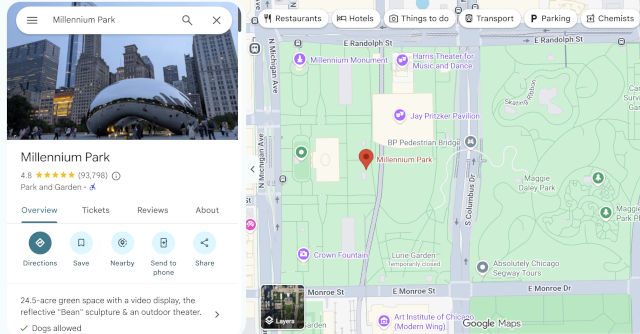
1. Search Google Images for a landmark in your city. For instance type "Millennium Park" not just "Chicago."
2. Click Tools > Usage Rights > Creative Commons licenses so you're only pulling images you can legally use.
3. Then click the image and confirm the license before downloading.
4. Rename the image to something that describes what you do e.g. "millennium-park-chicago-training-location.jpg" instead of "IMG_4521.jpg."
5. Write alt text that mentions the landmark and city. And credit the source in a small caption (most CC licenses require this).
If you can put three images per page you’re good to go.
Aim for one iconic landmark shot, one showing people training with a landmark visible in the background, and a neighborhood shot.
So a PT in the Denver area might use Red Rocks, the 16th Street Mall, and a wide-shot of where they do their training.
This tells AI (and humans) "Yes, this trainer is really here" before it even reads your copy.
Tactic 3: Information Consistency (Say The Same Thing, Everywhere, Always)

This is the one that quietly wrecks personal trainers who are doing everything else right.
AI doesn't just read your one page, it cross-references your business info. So if your name, address, or phone number is even slightly different in one place.
AI gets the digital jitters and is less confident you're a real, stable business. And if there’s someone near you who has that consistency, it’s more likely to recommend them.
So…
It's a tedious job. Which is why one of our services is to do it for you. Contact us here if you'd like your PT business to grow faster.
FAQ’s
What happens if I just keep doing what I’ve always done to get PT clients?
In the short term nothing.
If what you’re doing is working keep doing it. But the trick here is to also prepare for the future and the future is Google & AI. By doing the tactics I mentioned above you’re putting yourself in the best position for the future.
Does it really matter if I don’t have a website, location page or Google Business Profile for my PT business?
If you’re not bothered about putting yourself in with a chance of getting clients from Google. Then you don’t need a website.
However if you want to grow your business, having a website, a good location page and a Google Business Profile will definitely help your business grow.
How do I create a location page as a personal trainer?
A location page is just like any other page on your website. The difference is the content on that page is specifically about a location where you train.
So for instance, the images you use should be local images, FAQ’s should answer local questions and the title of the page should have a local title e.g. “Personal trainer in Lincoln Park.”
Conclusion
Generic location pages fail because AI can't verify vague claims — and unverified claims don't get cited.
Fix it by loading your page with structured, specific facts, proving you're really local with real landmark photos, and keeping your business details identical everywhere online.
Do these three simple tactics and your location page goes from wallpaper to the answer AI actually recommends.
Table of contents
Do You Want to Be Like Blockbuster or Netflix?
This Checklist Template For Personal Trainers Helps Your PT Business Grow
How To Make Your Location Page Loved By Google and AI
Tactic 1: Fact Density (Give Google & AI Real Helpful Data)
Tactic 2: Geographic Legitimacy (Prove You're Not a Ghost Gym)
Tactic 3: Information Consistency (Say The Same Thing, Everywhere, Always)